


 By Mark Hinnells, director of Susenco Consulting Ltd
Litigation on climate change is, quite literally, heating up! In the past few months there have been two reviews of climate change and litigation: the UNEP Global Climate Litigation Report: 2025 Status Review was published in October, and the Grantham Research Institute at the London School of Economics published a review in June. Both reviews rely on data from the Sabin Center for Climate Change Law at Columbia University, which maintains a database of US and global litigation.
Since 1986, when the first climate case was recorded, there has been a steady rise in the number of cases and jurisdictions involved, with a broadening range of legal arguments used, and increasingly diverse groups turning to law. As of 30 June 2025 a cumulative 3,099 climate-related cases have been filed in 55 national jurisdictions or 24 international or regional courts, tribunals or quasi-judicial bodies.
Cases fall into three main types:
- Cases against governments
- Cases against corporations
- As pro-climate litigation grows, so anti-climate cases are also onthe rise, particularly in the US.
To unpack those themes
Climate rights and policy failures
Courts are holding governments accountable for failing to meet statutory climate targets. For example, UK courts have twice ruled that the government’s climate strategies breach the Climate Change Act (Client Earth and Friends of the Earth v UK Government 2024). Similar challenges are emerging in other jurisdictions.
Climate and planning policy, much of which is in a quasi-judicial setting like public inquiries or planning appeals
Climate change is now a material factor in major planning decisions in the UK. Courts have required downstream emissions in environmental impact assessments: in the UK Finch v Surrey County Council 2024 and in Europe via Föreningen Greenpeace Norden and Natur og Ungdom v State of Norway (EFTA Court Advisory Opinion, May 25).
Climate and human rights
Cases are increasingly being brought by groups who feel themselves under pressure, for example youth, indigenous peoples and the elderly. Courts recognise the link between climate inaction and violations of rights to life, health and a healthy environment (KlimaSeniorinnen v Switzerland in the European Court of Human Rights in 2024, and Held v Montan, upheld in the Montana Supreme Court in 2024).
Climate, fiduciary duty and investing
Trustees in some jurisdictions face a lack of guidance, or conflicting perspectives, on the extent to which climate risks fall within fiduciary duty, though increasingly climate risks are seen as integral to both risk management and fiduciary duty. The Paris Agreement targets are written into Pensions legislation in the UK (Pensions Schemes Act 2021 S124).
Previously I have explored how, in the UK, in McGaughey v USS 2023 in the Court of Appeal, the Universities Superannuation Scheme faced a challenge in court on grounds of failing to perform fiduciary duty, but avoided being challenged on longer-term plans. In Canada the Supreme Court found that ‘climate change poses an existential threat’. As such, the duty of prudence requires a forward view, and duty of loyalty highlights a need to consider climate risk across generations.
Following that, four young people who will retire after 2050 are suing the Canada Pensions Plan Investment Board for failing to protect their pensions from climate risk.
Corporate liability
Shareholders are testing directors’ duties (including fiduciary duty) through climate-related claims. However, it seems corporate law is more laissez-faire than human rights law, and gives more freedom to directors to steer between conflicting interests of different stakeholders. I have previously reported on how courts are reluctant to impose specific climate strategies on directors, though directors are under increasing scrutiny to align corporate strategy with climate goals, for example ClientEarth v Shell, UK High Court 2023.
Climate and greenwashing
NGOs and consumers are increasingly using consumer protection and securities laws to challenge greenwashing. TotalEnergies in the Paris Court of Justice 2025 was perhaps the first major firm found guilty in France of misleading the public about its climate pledges.
Anti-climate cases
Including cases brought forward to delay or dismantle climate-related measures or actions, or to intimidate or silence climate advocates. For example, in 2024 Exxon sued climate activist investors in a bid to stop climate resolution from going to a vote at its annual investor conference.
Key conclusions include:
- The use of human rights law to frame state obligations on climate change is becoming common.
- Human rights law seems to be more in favour of the plaintiff than corporate law, which seems reluctant to interfere with the balancing act that directors have to perform to satisfy various stakeholders. I have previously explored how the use of human rights law will be aided by the recent influential but not binding judgements from the ICJ Advisory Opinion on Obligations Of States In Respect Of Climate Change in July 2025 and the Inter American Court of Human Rights (Advisory Opinion 32, July 2025).
- Courts and other adjudicatory bodies often require a clear, individualised and imminent harm to confer victim status – a threshold that is often difficult to meet given the nature of impacts of climate change. Climate attribution studies, such as exploring the likelihood of particular extreme weather events to emissions, will become increasingly important.
- The effectiveness of climate litigation depends on the remedy available. While lawsuits, even before a final decision, can exert pressure on legislatures and companies to change, the absence of strong enforcement frameworks or institutions, especially transnationally, limit the practical impact of climate rulings.
- Cases have increased by close to an order of magnitude since 2000. The US accounts for half of cases, representing the polarised nature of the debate in the US, as well as the litigious nature of the society. The UK accounts for 10% of cases, showing the importance of climate as a policy issue. Policy challenges or failure to meet targets account for 45% of cases, human rights 12% and cases aimed at the private sector (fiduciary duty, corporate liability and greenwashing) account for 43%.
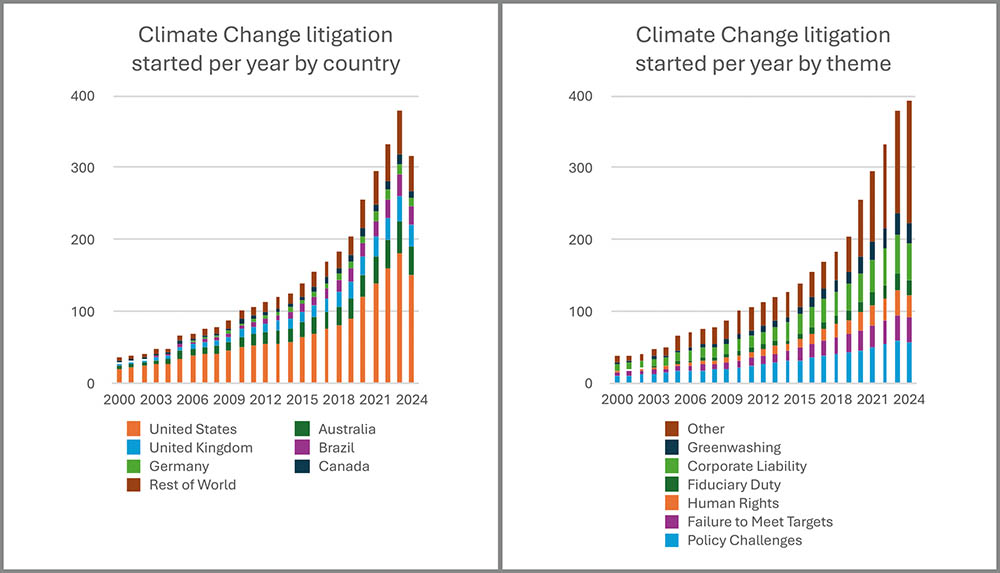
In conclusion, climate change is increasingly a point of dispute and friction between stakeholders, ranging from NGOs and campaigners through to shareholders, private citizens, directors, regulators and government ministers. Within the client base of every large legal firm will be a larger client who, if they don’t have a case right now, will have one brewing, either in their own business or within their upstream supply chain or downstream customer base.
The preferred route, when there is friction between stakeholders, is clearly to reach a solution together through collaboration or arbitration. However, the risk of litigation is clearly heating up. Susenco would be very pleased to help with finding a resolution – or failing that, supporting litigation.
Dr Mark Hinnells Energy and Climate Change Expert
T: 01865 600161
E: This email address is being protected from spambots. You need JavaScript enabled to view it.
W: www.susenco.com